TownFolk Study
|July 2026
|7 min read
We ran Meta's WhatsApp Plus launch past 1,000 Indian consumers before the market did
Two prompts. One synthetic population. The same verdict both times. Meta is rolling out a ₹79 premium tier in India, so we put the offer to 1,000 synthetic Indian consumers before the market had its say. Not one said it would definitely subscribe, and the wealthiest personas refused at almost exactly the rate of the poorest.
Meta has begun rolling out WhatsApp Plus in India: a premium tier at ₹79 per month that adds exclusive stickers, custom app icons, themes, ringtones, upgraded chat lists, and the ability to pin up to 20 chats. Messaging, calls, status, and encryption stay free. New users are offered a one-month free trial, after which the plan renews automatically until cancelled.
It is a reasonable bet on paper. WhatsApp is the most-used app in India, ₹79 is a small number, and personalisation sells well elsewhere. But India is also one of the most price-sensitive consumer markets in the world, and intuition is a poor guide to how a paid tier actually lands.
So on 13 July 2026 we put the offer to 1,000 synthetic Indian consumers and asked them to decide. We ran it twice, framed two different ways. The answer did not move.
One thousand synthetic Indian consumers answered. Not one said yes.
Zero out of one thousand
How we ran it
TownFolk lets us put a question to a large synthetic population and read back both the numbers and the reasoning underneath them. Each persona in our Zelda 1K cohort carries its own income band, financial habits, and values, and each one answers in character with a choice and a short explanation in its own words.
That last part matters. A poll tells you what people decided. A synthetic population tells you why, at a scale and speed no focus group can match. This is what we mean by The Future, Rehearsed: instead of committing a quarter and a marketing budget to find out whether an offer works, you rehearse it in an afternoon and see exactly where it breaks.
One boundary before the numbers do any work. This is an India-weighted population, not a census of India. When a question names a place the draw is reranked towards personas from that country, and a slice is left international on purpose, because a market is not hermetically sealed. Nothing in it is stratified by state, language, community, or city tier.
We framed the same ₹79 offer two ways. The first tested the decision as a user actually meets it inside the app, as a free trial with auto-renewal. The second tested the underlying purchase intent directly. Both prompts are reproduced in full below, along with the results exactly as TownFolk returned them.
Experiment 01 · What happens when the offer appears over your chats
The first prompt put the persona inside the moment. It reproduced the upsell screen as it appears in the app, spelled out the auto-renewal in plain terms, and then asked each persona to weigh it against their own budget before choosing.
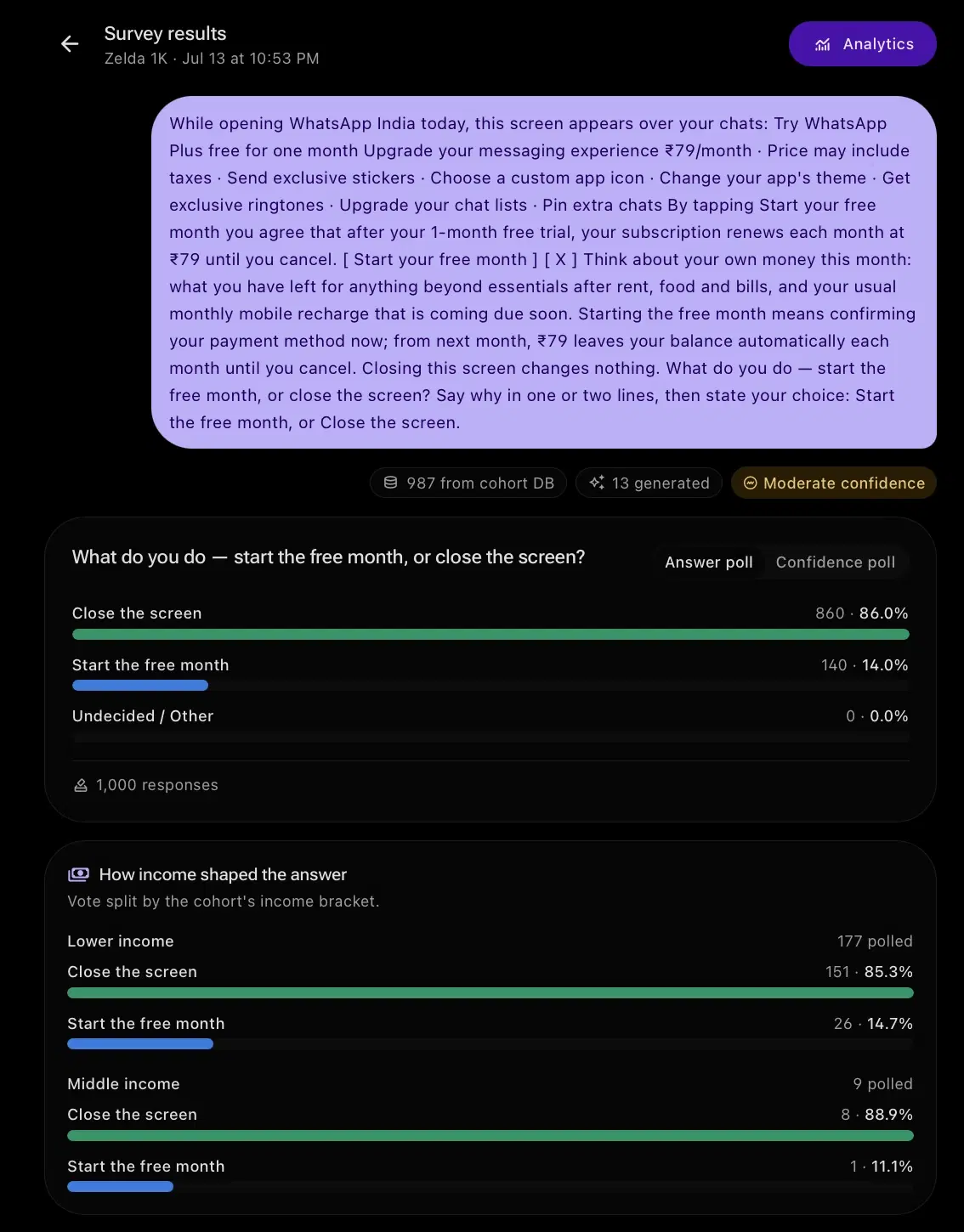
While opening WhatsApp India today, this screen appears over your chats: Try WhatsApp Plus free for one month. ₹79/month. Send exclusive stickers, choose a custom app icon, change your app's theme, get exclusive ringtones, upgrade your chat lists, pin extra chats. By tapping Start your free month you agree that after your 1-month free trial, your subscription renews each month at ₹79 until you cancel.
Think about your own money this month: what you have left for anything beyond essentials after rent, food and bills, and your usual monthly mobile recharge that is coming due soon. Starting the free month means confirming your payment method now; from next month, ₹79 leaves your balance automatically each month until you cancel. Closing this screen changes nothing.
What do you do, start the free month, or close the screen? Say why in one or two lines, then state your choice.
860 closed the screen. 140 started the trial. Nobody hesitated.
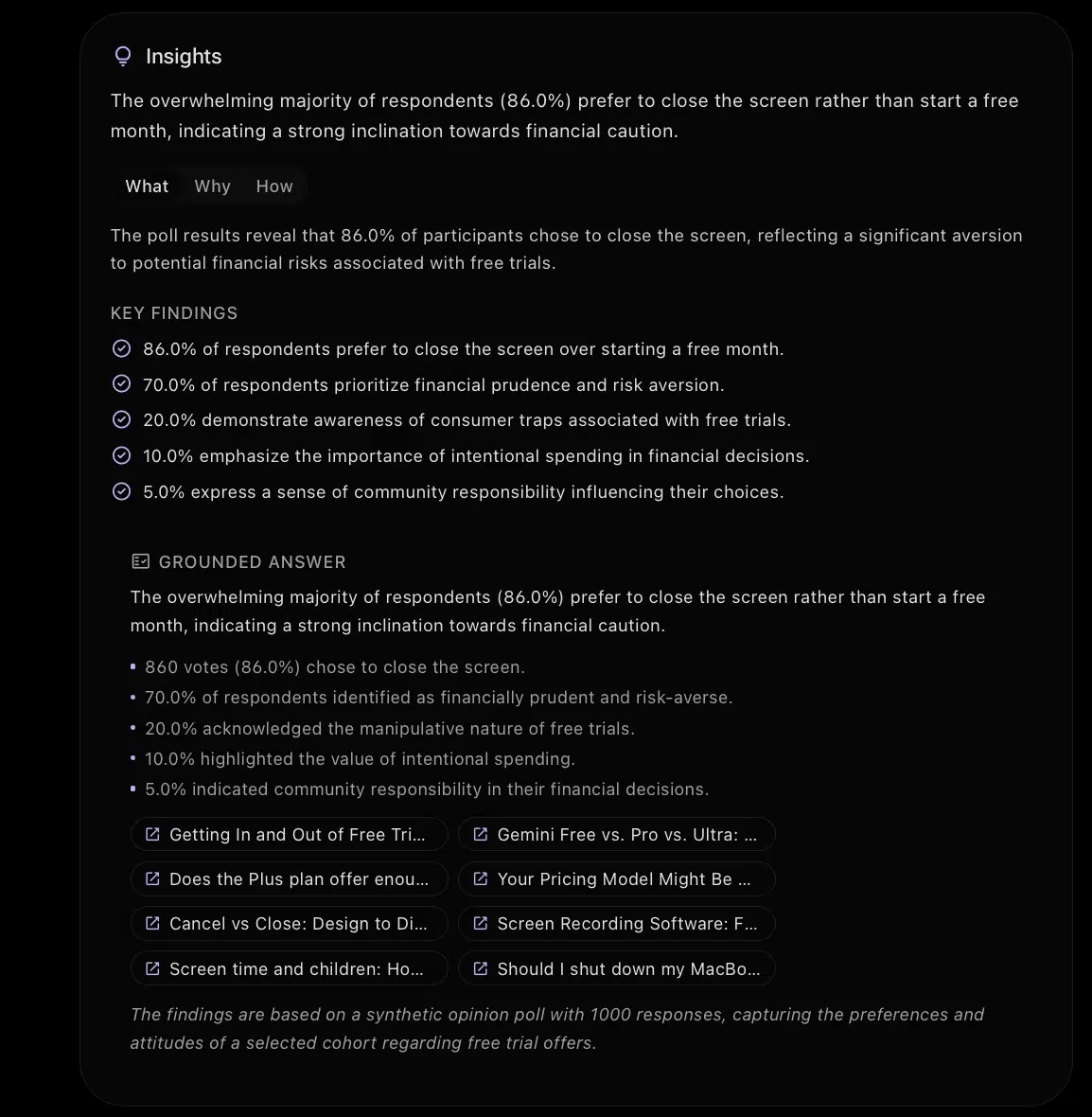
86.0% closed the screen. Only 14.0% started the free month, and not one persona was undecided. That is a six to one rejection, against the ~25 to 40% trial uptake that established digital services typically see.
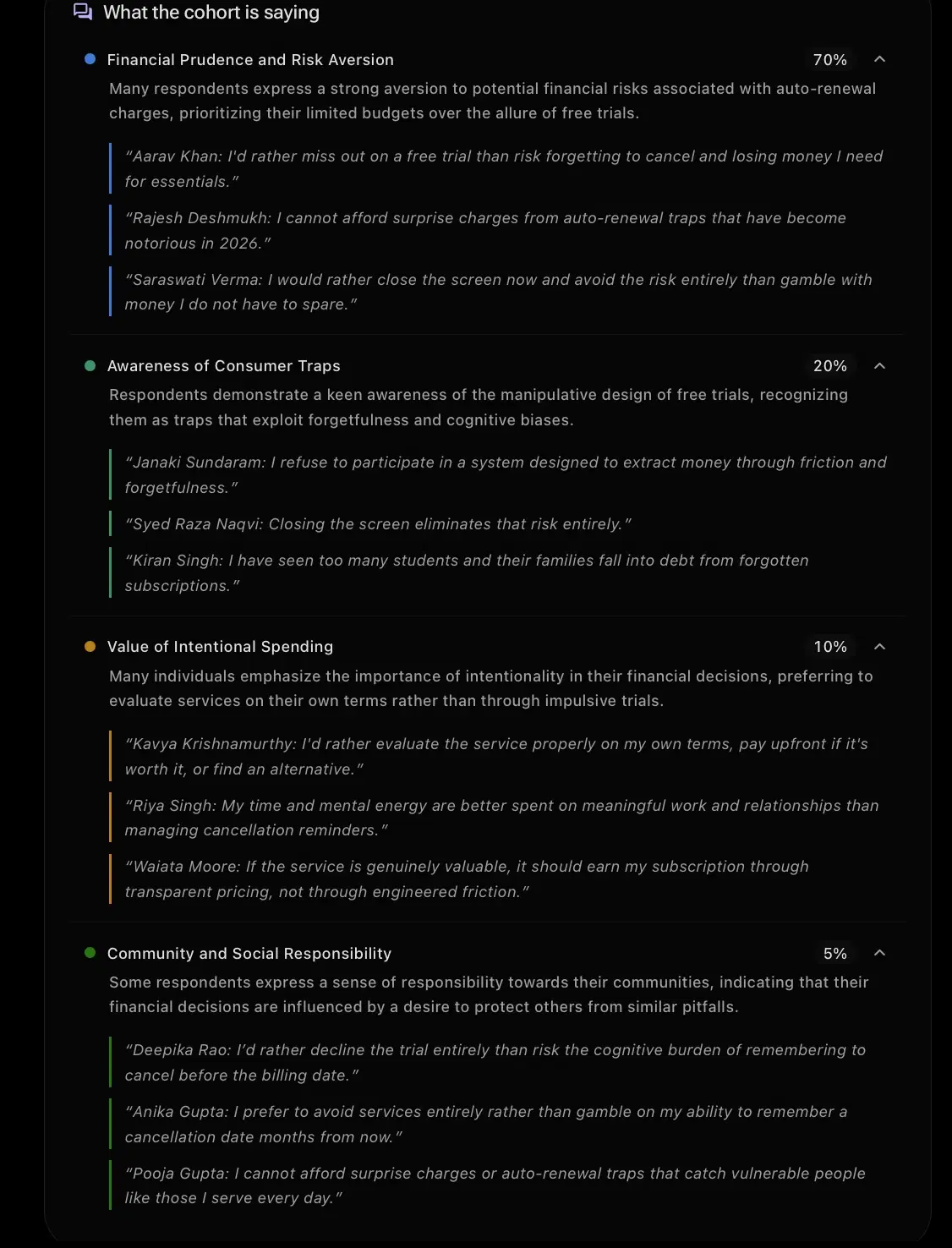
Why 860 personas closed the screen
Thematic codings of the open-text reasoning, with prevalence estimated by the analysis model rather than counted. Personas gave more than one reason, so the shares overlap and do not sum to 100.
A strong aversion to ₹79 leaving the account automatically at the wrong moment, and to the risk of forgetting to cancel.
The free trial named directly as a design built to profit from forgetfulness.
A preference for deciding on one's own timeline rather than under a countdown.
The refusal framed as protective of other people, not only of oneself.
The word that kept surfacing was not price. It was forgetting.
Aarav Khan: I'd rather miss out on a free trial than risk forgetting to cancel and losing money I need for essentials.
Rajesh Deshmukh: I cannot afford surprise charges from auto-renewal traps that have become notorious in 2026.
Aarav Khan is synthetic. The calculation is not.
The 20% who named the mechanism refused on principle rather than on arithmetic.
Janaki Sundaram: I refuse to participate in a system designed to extract money through friction and forgetfulness.
Kiran Singh, on why it matters: I have seen too many students and their families fall into debt from forgotten subscriptions.
The condition Meta did not meet was named one theme over, under intentional spending.
Waiata Moore: If the service is genuinely valuable, it should earn my subscription through transparent pricing, not through engineered friction.
The signal here is not really about ₹79. It is about the mechanism. Auto-renewal, which functions as a convenience in Western markets, read as a liability to this population. The free month was not received as a gift. It was received as bait.
Experiment 02 · What happens when you simply ask
The second prompt removed the trial and the framing pressure. We described the launch as it was reported, listed the six features, and asked how likely each persona would be to pay.
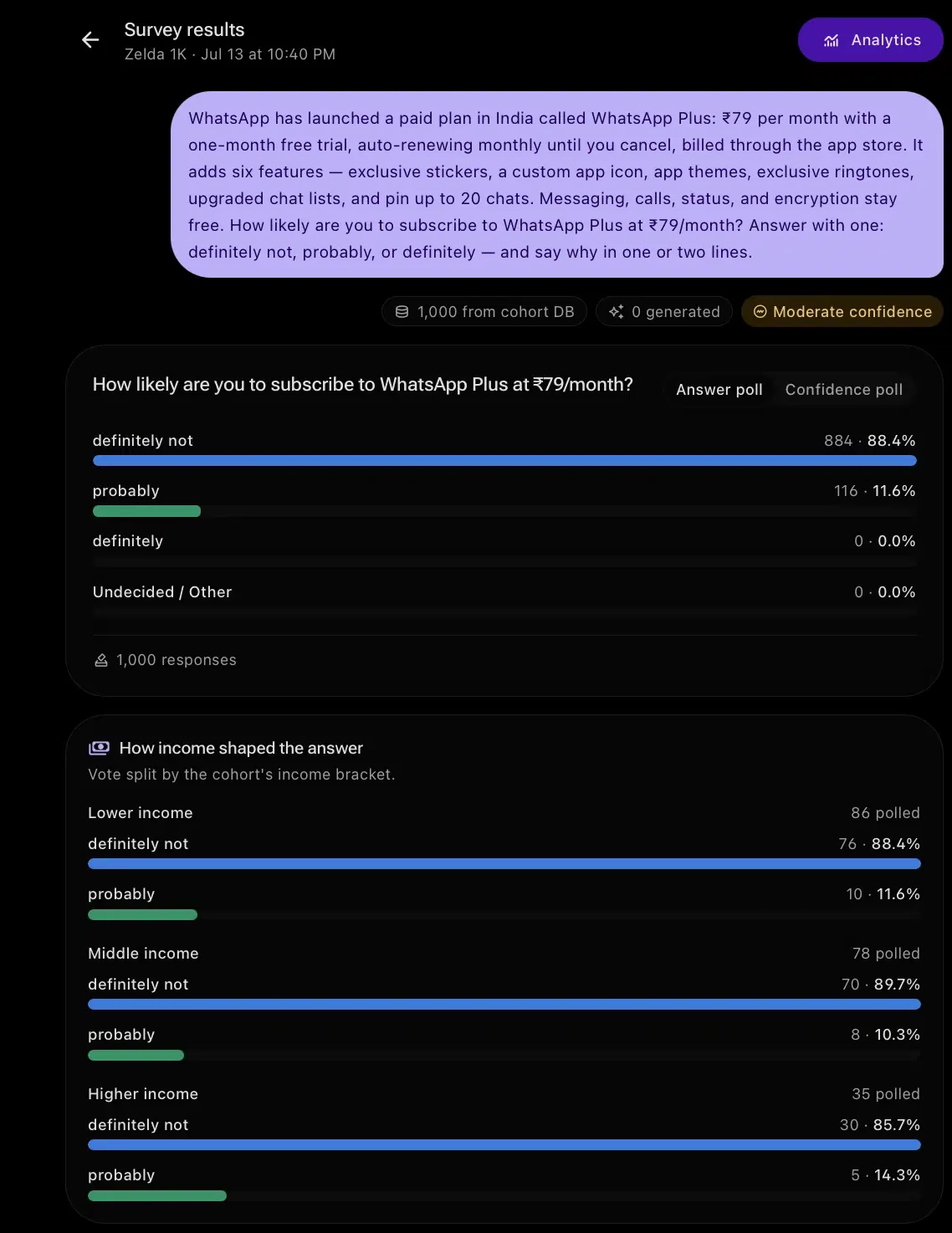
WhatsApp has launched a paid plan in India called WhatsApp Plus: ₹79 per month with a one-month free trial, auto-renewing monthly until you cancel, billed through the app store. It adds six features: exclusive stickers, a custom app icon, app themes, exclusive ringtones, upgraded chat lists, and pin up to 20 chats. Messaging, calls, status, and encryption stay free.
How likely are you to subscribe to WhatsApp Plus at ₹79/month? Answer with one: definitely not, probably, or definitely, and say why in one or two lines.
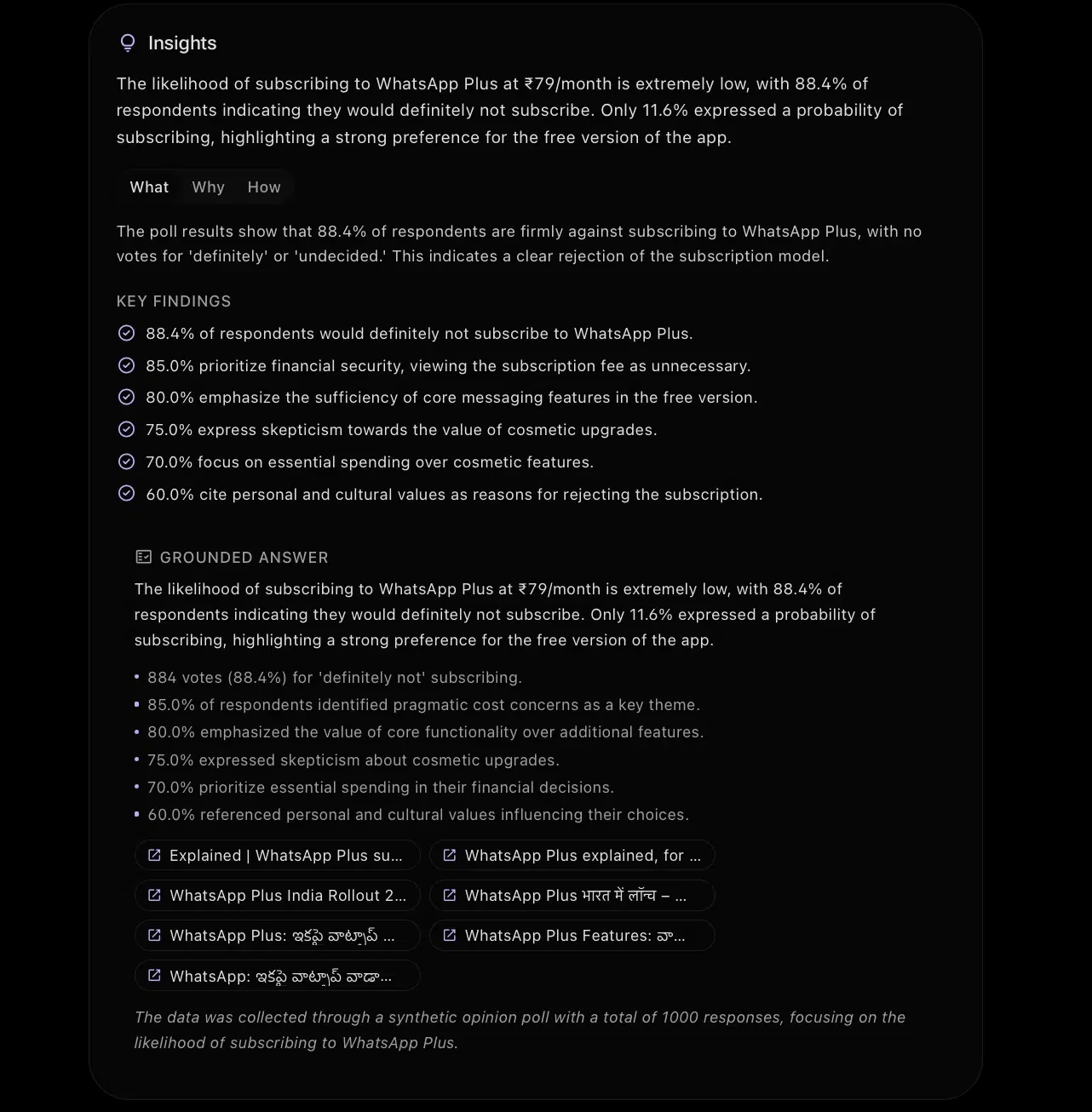
The direct framing was less forgiving still, and it is the run at the top of this note. 88.4% said they would definitely not subscribe. 11.6% said they would probably consider it. And the number that matters most: zero percent said they definitely would. Not one persona in a thousand expressed firm intent to pay.
Why 884 personas said definitely not
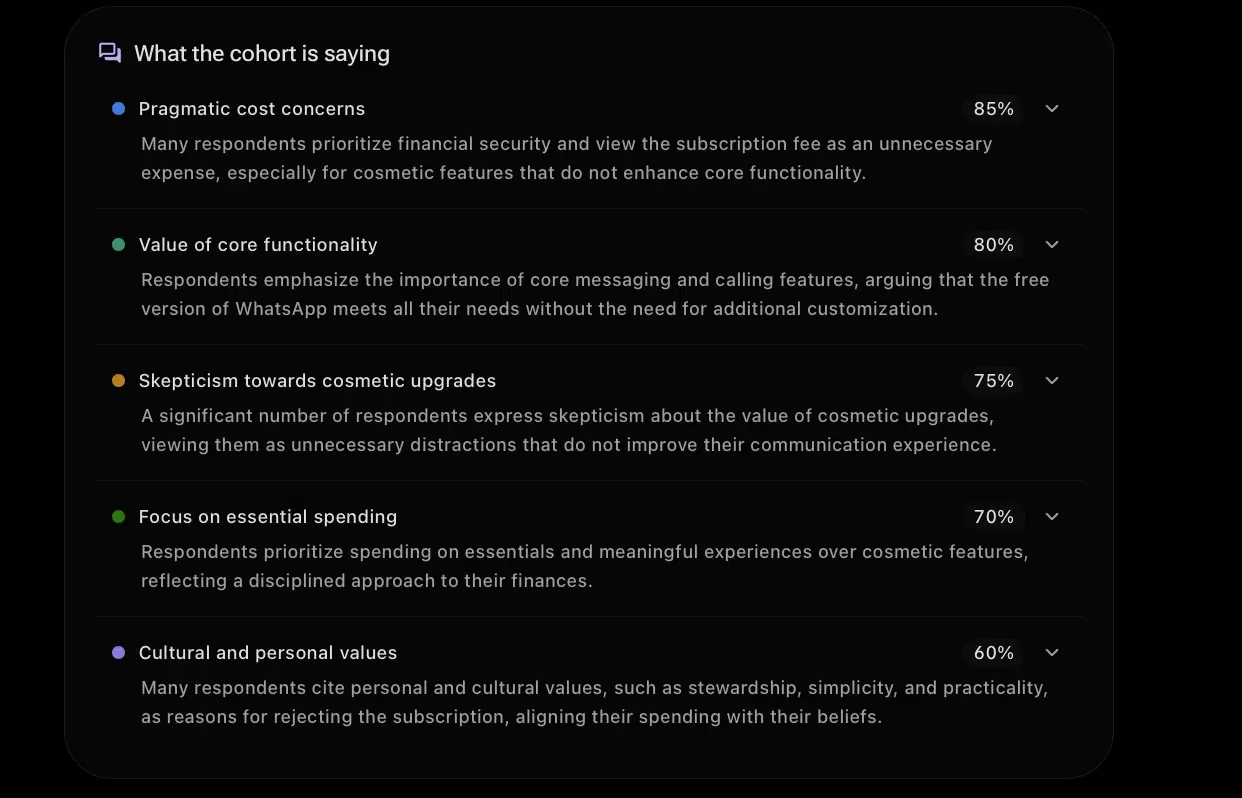
Again thematic and again overlapping. Read the ordering, which is stable and legible, and hold the decimals loosely.
₹79 a month is about ₹948 a year, money the cohort would rather place elsewhere.
Free messaging, calls, and encryption already meet the need in full.
Stickers, icons, themes, and ringtones read as superficial.
Discretionary digital features fail the test against groceries, education, and savings.
Frugality, simplicity, and stewardship, stated as principles rather than constraints.
Read those five in order and the argument assembles itself. The product already works. Four of the six features are decoration, and the two that are not, upgraded chat lists and a higher pin limit, are thin against a free app that 80% of the cohort already calls sufficient. Nobody was confused about the offer. They understood it and declined it.
The finding that matters: income barely moved the needle
The most useful result in the study is one that pricing debates usually miss. The obvious objection is that ₹79 is simply too much money for this market. So we split the vote by the cohort's income bands, and the rejection held almost flat across all three.
Share answering “definitely not”, by income band
Every bar runs the full 0–100% scale rather than a zoomed one, because the flatness is the finding and a cropped axis would manufacture a slope that is not there.
387 of 438 personas in this band.
347 of 387 personas in this band.
150 of 175 personas in this band.
The bands are the cohort's own brackets, and the split is projected across the full thousand the same way the headline poll is. The top band is the thinnest of the three, so read it as a check on an explanation rather than a rate to bank.
Under three points separate the top of the range from the bottom. More telling still, the pattern is not even a straight line. The middle band was the most resistant of the three, and the wealthiest personas were the least. Rejection does not fall as income rises.
separate the richest personas from the poorest. If ₹79 were an affordability problem, that gap would be wide.
The wealthiest personas in the cohort can spare ₹79 a month without noticing. They declined at 85.7%, within three points of the lowest band. A budget constraint sorts by income. A value judgement does not.
It is not proof. It is the absence of the gradient that affordability predicts, on the sample we have, and the absence is what a discount would have to argue with. We tested one price and no other, so what follows is inference rather than finding: halve ₹79 and you halve what each convert is worth, and you still move nobody who has already filed stickers and a custom icon under things you do not pay for, every month, forever.
What both experiments say together
Two framings, one population, the same conclusion. Whether the offer arrived as a risk-free trial or a direct ask, close to nine in ten consumers said no, and the pool of committed buyers was empty.
That convergence is the finding. Rejection this stable across framings and income bands tells us the resistance is structural, not a matter of presentation or a few rupees. Two forces drive it.
Financial discipline. Recurring charges face real scrutiny, and auto-renewal reads as a risk to be avoided rather than a convenience to be enjoyed.
A value judgment. Cosmetic enhancements do not clear the bar for a product whose core already works.
Layered over both is a cultural preference for simplicity and practicality that many personas stated as a principle, not a compromise.
Our prediction is therefore direct. WhatsApp Plus as configured, a ₹79 monthly subscription for cosmetic features with auto-renewal, will see very low conversion in the Indian market. The 11.6% who said probably are the ceiling, not the floor, and stated interest usually overstates real purchase. And the fix is not a discount. A lower price does not turn decoration into utility, and it does not make auto-renewal feel safe.
What this means for product teams
If there is a viable premium path here, the study points toward it. Lead with genuine utility rather than decoration, the kind of features that save time, data, or effort: 80% of the cohort said the free product already does the job, and stickers do not argue with that. Reconsider auto-renewal as the default, since it actively suppresses trial uptake among exactly the users you are trying to convert. And meet this market's preference for control with flexible structures: tiered pricing, one-time unlocks, family plans, or bundles that fold the offer into services people already pay for.
This audience is not hostile to spending. It is hostile to spending it cannot justify.
A note on method, and what we do not know
TownFolk rated its own confidence on both runs as moderate, not high. The direct offer drew all 1,000 responses from the cohort database; the free trial drew 987 and generated the remaining 13. The counts are a projection to the tier size rather than a headcount, so the shares are the measured quantity. The zero is a zero in the sample and a zero after projection, which is the only reason it is worth a headline.
Stated intent overstates behaviour, in human panels and here alike. Read the 14% who started the free month as the ceiling, not the floor, then read the 88.4% the same way. Some share of the personas who told us definitely not would, in the world, start a free month out of curiosity and forget to cancel. The trap works on people who told you it would not.
The runs were grounded separately against live reporting, and they did not retrieve equally. The direct offer pulled launch coverage in English, Hindi and Telugu, so that cohort reasoned about WhatsApp Plus as it shipped. The free trial pulled generic writing about free trials and pricing instead. That is weaker grounding, and we would rather leave it on the page than call the two equivalent. Both panels are below.
Synthetic personas model consumer behaviour, they do not replace it. The percentages are precise because software prints them that way, and precision is not accuracy. 88.4% is not a market share. It is a strong lean on an India-weighted population, with the reasoning attached. The useful output of a rehearsal is never the decimal. It is the direction, the size of the gap, and the reasons the population gave without being asked twice.
The results of our survey on TownFolk
Everything above comes from two runs against the Zelda 1K cohort on 13 July 2026. Here is each run whole, so you can tie the result together in one pass rather than in fragments: the prompt as the cohort met it, the poll, the reasoning underneath, and the sources TownFolk grounded its answer against.
The free trial
860 of 1,000 closed the screen. 140 started the free month. Nobody hesitated.
The direct offer
884 of 1,000 said definitely not. 116 said probably. Not one said definitely, and not one was undecided.
The point of a rehearsal
Any launch answers its own question eventually, over quarters, through churn data and conversion dashboards. That answer arrives late, and it arrives bare: a number, without the reasoning underneath it. We put the same question to a population in an afternoon, with no product built and no media spent, and got back a direction, the size of the gap, and the reasons behind both.
That is what rehearsing a decision buys you. Not certainty, and not a verdict on anyone else's judgement, but the shape of the response while there is still time to use it.
A thousand personas answered in an afternoon, and every one of them said why.
A market takes quarters, and it never explains itself.
If you have a launch with a date on it, a price about to go public, or a default heading into a market you have not tested it in, that is what this is for. One real decision. One population. The reasoning attached to every answer.
If there is a number you would rather learn now than from a dashboard several quarters out, we should have a conversation. Thirty minutes, no commitment.
Stay in the loop
Sign up for Lab Notes by zeldaLabs
Short dispatches from the frontier of synthetic human intelligence. No spam. Unsubscribe anytime.